
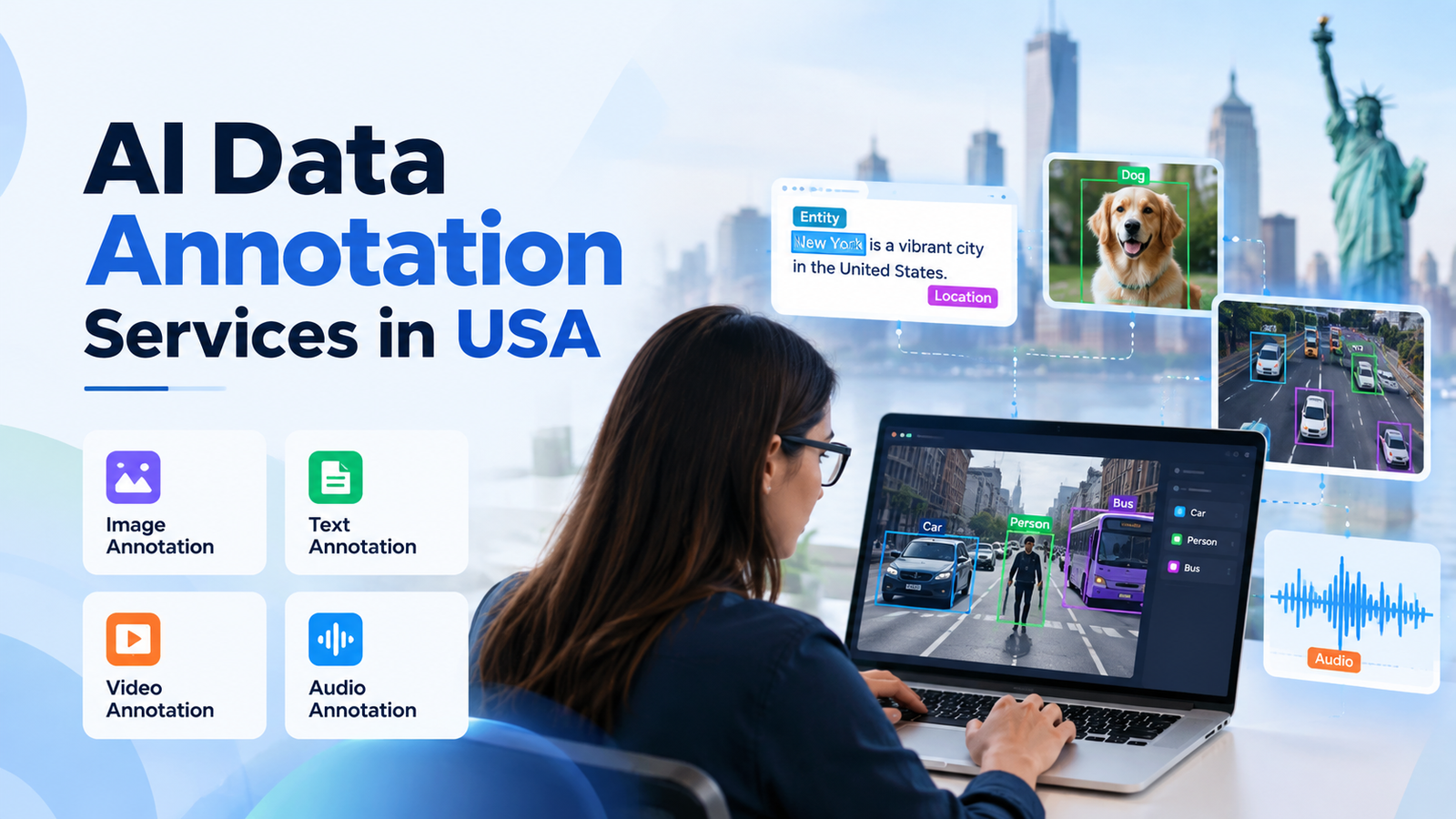
A machine learning model learns from the examples it receives. When those examples are incomplete, poorly organized, or incorrectly labeled, the model can learn the wrong patterns. This is why data preparation matters as much as choosing an algorithm. Images, videos, and text must be checked, organized, annotated, and reviewed before training begins.
AI Data Annotation Services in USA help businesses turn raw information into structured datasets. A retailer may need product images labeled, a manufacturer may need defects marked on parts, and a transport company may need vehicles tracked across video frames.
What Is Data Annotation in Machine Learning?
Data annotation adds labels to raw data so a machine learning model can learn patterns. AI Data Annotation Services apply these methods according to the model’s data and labeling requirements. A label may describe a whole image, identify an object, mark an activity in a video, or classify the meaning of a text message.
Common approaches include image classification, object detection with bounding boxes, image segmentation that marks pixels, video labeling that tracks objects across frames, and text annotation that identifies names, topics, or intent. The method depends on what the model must do. A useful dataset is not just large; its labels must be accurate, consistent, and relevant.
Why Dataset Preparation Matters
A large dataset can still be unsuitable for training. Images may be blurred, files duplicated, records missing, or labels inconsistent. For example, if a safety-helmet image is incorrectly labeled “no helmet,” the model receives conflicting information and may later miss a helmet or trigger a false alert.
A structured workflow from AI Data Annotation Services in USA checks source files, applies agreed rules, and confirms that examples reflect the conditions in which the model will operate.
How AI Data Annotation Services in USA Prepare Datasets
A typical project follows these connected stages.
1. Understand the Project Objective
First, define what the model must recognize or predict. A warehouse package detector has different needs from a system that extracts invoice details. The brief should cover the business problem, expected output, data type, categories, and operating conditions. It should also settle edge cases, such as partly hidden objects or minor product defects.
AI Data Annotation Services in USA can review sample files and clarify the level of detail before work begins. Clear requirements reduce rework.
2. Collect and Organize Relevant Data
Data may come from cameras, recordings, scanned documents, product catalogs, or approved business records. Collection should reflect real conditions: a traffic model may need daytime, night, rain, and different camera angles.
Organize files with consistent names, IDs, folders, and metadata. Check formats, remove duplicates, and flag unreadable or irrelevant records so every label can be traced to its source. In multi-source projects, AI Data Annotation Services in USA should preserve the link between each original file and its completed label.
Good organization makes it easier to assign work, investigate labeling questions, and prepare the final export.
3. Check Data Quality and Coverage
Review the data for blur, low resolution, corrupted files, missing frames, duplicates, and incomplete documents. Correct, set aside, or exclude unusable records.
Coverage also matters: a product model trained only on front-facing images may struggle with tilted or partly covered items. Use simple statuses such as “ready,” “needs correction,” and “exclude.” AI Data Annotation Services in USA can apply these checks consistently.
The goal is to build a dataset that represents the situations the model is expected to handle, rather than relying on a large collection of similar examples.
4. Write Clear Annotation Guidelines
Guidelines define each label, object boundary, exception, and response to unclear cases. For damaged packages, clarify whether small scratches count, how to mark crushed corners, and what to do when an item is partly out of view.
Add positive and negative examples and a way to ask questions. A pilot batch lets reviewers find unclear instructions before full-scale work. This preparation is a core part of AI Data Annotation Services in USA.
For a successful annotation project, everyone involved should follow the same instructions. Otherwise, different annotators may apply different meanings to identical situations, creating inconsistencies in the final dataset.
5. Apply the Right Annotation Method
Choose a method based on the model’s output, not just what is easiest to label.
Image annotation
Image work may involve whole-image classification, bounding boxes, polygons, or pixel-level segmentation. AI Image Annotation Services support product recognition, manufacturing inspection, agriculture monitoring, and object detection.
Some projects combine these methods, so the annotation plan should specify which labels are needed for each data subset. A manufacturer may label scratches, dents, cracks, and acceptable surfaces. Guidelines should define each defect and explain overlapping or partly visible areas.
The method must match the model’s intended output; AI Data Annotation Services in USA should confirm this before work scales. For detailed defect boundaries, AI Image Annotation Services may combine boxes with segmentation labels.
Video annotation
Video labels must preserve continuity between frames. A vehicle or person may need one tracking ID, along with labels for actions and events. AI Video Annotation Services support traffic analysis, retail movement, and workplace safety.
The required frame sampling rate and level of detail should be agreed in advance because they affect both the workload and the consistency checks. If tracking changes from frame to frame, a system may lose an object or count it twice.
Instructions should cover objects that leave and re-enter a camera view. AI Video Annotation Services can also attach event timestamps when models must identify when an action begins or ends.
Text and document annotation
Text annotation can classify customer messages, identify names and locations, tag topics, or extract document fields. A support model may sort messages into billing, technical support, cancellations, and general inquiries.
Guidelines should cover spelling errors, mixed languages, unclear intent, and messages that fit multiple categories. AI Data Annotation Services in USA should document how ambiguous messages are handled rather than forcing every record into a category. Agree on secure handling before annotating confidential files.
6. Review Labels and Measure Quality
Reviewers should check whether labels follow the guidelines and match the source data. They can sample completed records, compare annotators’ work, inspect box placement and segmentation boundaries, and confirm video tracking IDs. Text labels should be checked against the original content.
Track agreement, error rates, and recurring issues using measures suited to the task. Correct mistakes and decide whether feedback or clearer instructions are needed.
AI Data Annotation Services in USA should address repeated causes, not just isolated errors.
For example, if several annotators repeatedly confuse two product categories, the team should review the definitions and provide clearer examples. This helps prevent the same issue from appearing throughout the remaining dataset.
7. Export and Prepare the Dataset for Training
Export reviewed data in a format that fits the workflow. Object detection projects may use COCO or Pascal VOC, while structured labels may use JSON or CSV.
Include class names, field meanings, file references, and version details. Split data into training, validation, and test sets, and avoid leakage—for example, do not scatter near-identical frames from one video across all sets.
AI Data Annotation Services in USA should provide a clear handover for the development team.
The handover should make it easy for machine learning engineers to understand the dataset structure and connect it with their training pipeline. A well-organized delivery also makes future updates easier to manage.
8. Protect Data and Keep Project Records
For projects involving customer records or confidential documents, agree on access, storage, transfer, retention, and deletion before work begins.
Limit access to people who need the data and review applicable client, contractual, and regulatory requirements. Record dataset versions, guideline changes, quality checks, exclusions, and known limitations so issues can be traced later.
AI Data Annotation Services in USA should follow the agreed retention and deletion process when a project ends.
Maintaining proper records also helps businesses understand how a dataset was prepared and which guidelines were followed. This is particularly useful when a machine learning project needs additional data or updated annotations in the future.
A Practical Example: Preparing a Retail Product Dataset
An online retailer wants a model that recognizes products on shelves. It collects images from different stores, lighting conditions, shelf layouts, and camera angles.
After removing duplicates and poor-quality files, annotators draw boxes and apply category labels. Guidelines explain how to label partly hidden products. Reviewers correct inconsistent work, then the dataset is exported and divided into training, validation, and test groups.
Every stage affects the usefulness of the final data. This is the kind of connected workflow AI Data Annotation Services in USA should plan around the retailer’s model requirements.
The example demonstrates why businesses should not focus only on the number of images annotated. Data variety, clear instructions, and proper quality checks are equally important.
Common Challenges and How to Address Them
Class imbalance means rare objects or events have too few examples. Review label distribution and, where possible, collect more samples of underrepresented classes.
Unclear instructions cause inconsistent decisions; pilot batches and edge-case examples help.
Changing requirements should be handled through versioned guidelines so old and new labels are not mixed.
Finally, do not measure success by speed alone. Allow time for a pilot, annotation, review, and correction. Businesses working with AI Data Annotation Services in USA should agree on quality targets and escalation steps before production starts.
Addressing these challenges early helps businesses avoid unnecessary corrections and keeps the dataset aligned with the machine learning project’s requirements.
How to Choose an Annotation Partner
Do not compare providers only by daily volume. Ask how they define requirements, prepare guidelines, train annotators, review difficult cases, and report quality.
Check experience with your data type, availability of a pilot batch, dispute handling, delivery formats, and data security practices. Ask how AI Data Annotation Services will keep the annotation process aligned with model updates.
Businesses evaluating AI Data Annotation Services in USA should explain how the dataset will be used. A reliable partner will ask about the model objective and discuss limitations honestly.
Here are a few important questions to discuss before starting:
- Can the team handle the required image, video, or text annotation method?
- Does the provider have a defined quality review process?
- Can it deliver data in the required format?
- How will project updates, corrections, and data security be managed?
A good provider should understand the purpose of the dataset and be willing to explain how the proposed workflow supports the project.
Why Choose Vision Infotech?
Vision Infotech has been a software outsourcing partner since 2012, with services in custom software development, AI development, AI consulting, Zoho customization, and AWS consulting. This technology background is useful because annotated data must fit the model objective, data pipeline, and wider software environment.
Vision Infotech can discuss data types, labels, quality expectations, delivery formats, and how preparation connects with an AI solution. Sharing sample files, categories, timelines, and data-handling needs helps define a practical project scope.
For businesses planning wider AI development, AI Data Annotation Services in USA can form one part of a connected technology engagement.
Here are some reasons businesses can consider Vision Infotech for their technology projects:
- Experience since 2012: A background in software outsourcing and technology development.
- AI development knowledge: Services covering AI development and AI consulting.
- Custom technology solutions: Experience across custom software development and business technology.
- Connected technology services: Capabilities spanning AI, Zoho customization, and AWS consulting.
- Requirement-focused discussions: An approach that starts with understanding project goals, data requirements, and expected outcomes.
The focus is on understanding the actual business requirement and connecting the proposed technology approach with the wider development plan.
Conclusion
Preparing a machine learning dataset takes more than collecting files and adding labels. Businesses must define the goal, gather representative data, check quality, set guidelines, annotate, review, and export usable files. Data protection and documentation matter too.
Well-prepared data gives developers a stronger foundation for training and evaluation. It cannot guarantee perfect performance, but it can reduce avoidable errors. With a clear workflow and a technology partner who understands the wider project, businesses can turn raw information into structured data for machine learning.
 taper.empire
 semon.ashley
 matt.bennett