
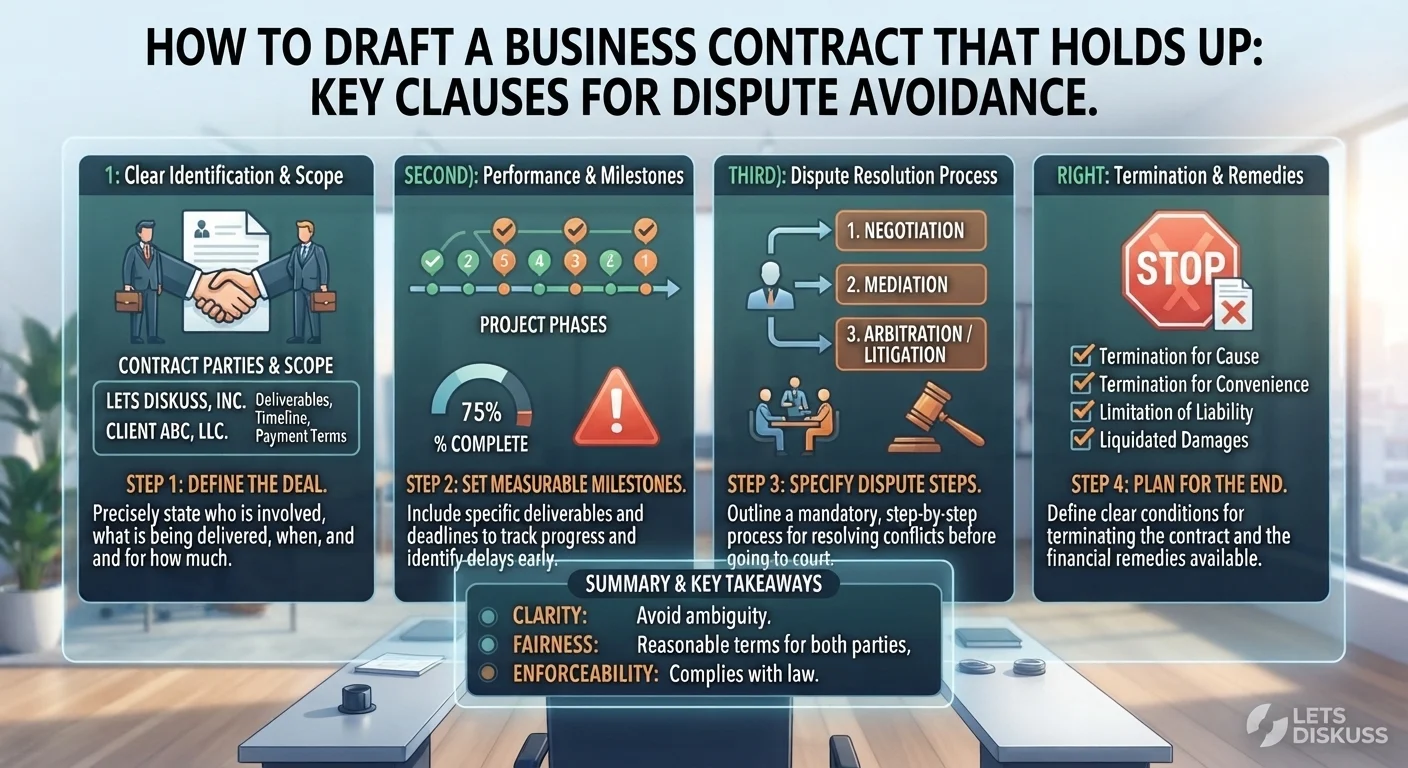
A friend of mine runs a small marketing agency, and a few years back he lost $18,000 on one sentence. His contract said the client would pay “upon completion.” The client decided the project was never complete, because they kept asking for changes. Nobody had defined what “complete” meant.
That’s how most contract disputes start. Nobody sets out to cheat anyone. Two people simply read the same vague line in two different ways, and by the time they notice, the money is already in the middle.
A business contract is a promise written down so that memory, mood and misunderstanding can’t rewrite it later. World Commerce & Contracting found that the average business loses almost 9% of its value every year through poor contract management, and the worst performers lose 15% or more. A lot of that loss traces back to the drafting stage, long before anyone gets to court. worldcc
So let’s go through how to write one properly.
What Makes a Contract Legally Valid
The Core Elements
Under general business law, a contract becomes enforceable when a few basics are in place. One side makes an offer, the other accepts it, and both exchange something of value, which lawyers call consideration. Both sides must also be legally able to sign, and the deal can’t be for something illegal.
That’s the whole foundation. Everything else in a contract is there to make those basics clear and provable.
When a Contract Must Be in Writing
People often assume a handshake deal doesn’t count. It can count, but proving what was said is a nightmare. In the US, some agreements must be in writing under the Statute of Frauds, including contracts for land, deals that can’t be finished within a year, and sales of goods worth $500 or more under UCC §2-201. Other countries have their own versions, so check the rules where you operate.
Prepare Before You Start Writing
Collect Your Facts First
Most bad contracts are bad because the writer started typing too early. Before you open a blank document, get the boring details right: the full legal name of each party, the registered address, and the name of the person who has authority to sign.
This sounds small, but it isn’t. If your client is “Bright Path Solutions LLC” and you write “Bright Path,” you may struggle to chase the right entity when payment stops. Companies and their trading names are not always the same thing, and a sole trader and a limited company carry very different risks for you.
Then write down, in plain notes, what is being delivered, by when, for how much, and what should happen if something breaks. If you can’t explain the deal in a few sentences to a stranger, the contract won’t be clear either.
A Layout Judges and Clients Can Follow
You don’t need fancy structure, but you do need a predictable one. Start with a clear title like “Website Design Services Agreement” rather than just “Agreement,” then name the parties and add a short background paragraph explaining why the contract exists.
After that, put your definitions in one place, followed by the scope of work, payment terms, how long the deal lasts and how it ends, then the risk clauses, and finally the legal housekeeping and the signature block.
Readers should find any clause within seconds. A contract that jumps around forces people to hunt, and hunting leads to mistakes.
Writing the Clauses That Matter Most
Write Like a Person, Not a Law Textbook
Here’s something many first-time drafters don’t know. When a clause is unclear, courts in many places lean toward the reading that goes against the person who wrote it. This is called contra proferentem, and it means your confusing sentence can be used against you.
So skip the old-fashioned language. Words like “heretofore” and “witnesseth” don’t make a contract stronger. They make it harder to read, and hard-to-read contracts get argued about.
Short sentences work better. Say “The client must pay each invoice within 14 days” instead of “Payment shall be remitted by the client in a timely manner following receipt of any invoice.” The first version can be checked against a calendar. The second can’t.
Pick one name for each thing and stick with it. If page one says “the Services,” don’t call it “the Work” on page five. A different word can be argued to mean a different thing.
Define the Scope So Nobody Can Stretch It
Scope creep ruins more working relationships than outright dishonesty does. A contract that says “website development” and nothing else leaves room for the client to expect hosting, copywriting, photography and a year of free fixes.
Say what you will do, how many rounds of changes are included, what format the final files come in, and how the client approves the work. Then say what is not included. A line such as “Extra revisions after round two are billed at $85 per hour” ends an argument before it begins.
It also helps to define what “done” means. Go back to my friend’s agency. If the contract had said the project is complete when the client approves the final design in writing or ten days pass without feedback, he would have kept his $18,000.
Payment Terms Deserve More Space Than They Usually Get
Money clauses should be almost boringly specific. State the total fee or hourly rate, whether a deposit is needed, when each payment falls due, and how the client can pay. Mention the currency too, because a deal between a Latvian company and a US client can easily turn into a fight over exchange rates.
Late payment is where many small businesses bleed quietly. Net 30 is the usual standard, and some industries stretch to Net 60 or Net 90, which can strangle a small supplier’s cash flow. Decide what you can live with and write it in.
If you add a late fee, keep it sensible. In many places a fee far bigger than your real loss can be thrown out as a penalty, while a fair pre-agreed estimate of damages, known as liquidated damages, is usually accepted.
Deciding Who Carries the Risk
This is the section people skim, and it’s the one that matters most when something goes wrong.
A limitation of liability clause caps how much one side can owe the other. A common approach is to limit it to the fees paid in the previous 12 months. Without a cap, a $5,000 project can create a $500,000 problem.
Indemnity is where one party agrees to cover the other’s losses from a specific event, for example if the work you delivered turns out to copy someone else’s copyright. Keep it narrow. If you’re signing a contract that says you’ll cover “any and all claims,” stop and think before you sign.
Confidentiality is simpler but still needs care. Say what counts as confidential, how long the duty lasts (two to five years is common), and what the exceptions are, such as information that is already public or that the law forces you to disclose.
Finishing the Draft and Getting It Signed
Plan How the Contract Ends
Most people write a lot about how a deal starts and almost nothing about how it stops. That’s backwards.
Decide whether the agreement runs for a fixed period or renews on its own. Set a notice period for leaving, which is often 30 days for service work and 60 to 90 days for bigger supply deals. Say which breaches allow immediate termination and which give the other side a window, often 10 to 30 days, to fix the problem first.
Auto-renewal clauses deserve special attention. A contract that quietly renews for another year because nobody sent notice 60 days earlier is one of the most common ways businesses get stuck paying for things they no longer want.
The Small Print That Decides Where the Fight Happens
Governing law and jurisdiction sound dull until you’re in a dispute. If you’re based in Riga and your client is in Texas, whose law applies and which court hears the case becomes a very real question. Settle it in advance.
Most contracts also include a clause on how disputes are handled, usually starting with direct talks, then mediation or arbitration, and court only as a last step. Arbitration is faster and private, though your right to appeal is limited.
There are a few other short clauses worth including. An entire agreement clause says the written contract replaces earlier emails and verbal promises. An amendment clause says changes only count if both sides sign them. Force majeure covers events nobody can control, and since 2020 most lawyers name pandemics and supply-chain shutdowns directly instead of trusting a general phrase. A severability clause keeps the rest of the contract alive if a court strikes out one part.
Read It Like the Other Side Would
Before you send the draft, read it once as your opponent. Where would a clever person find a gap? Check that the numbers in the text match any attached schedules, that dates are right, and that cross-references still point to the right clauses. A reference to “clause 9.2” after clause 9.2 was deleted is surprisingly common.
For signing, electronic signatures are legal for most business deals. The ESIGN Act and UETA cover them in the US, and eIDAS does the same across the EU. Keep a fully signed copy with every page and attachment, and make sure both sides get one.
After the Signature
Managing the Contract Over Time
The same WorldCC research shows that most lost value appears after a contract is signed, not before. Deadlines get missed, renewals roll over, and obligations get forgotten because nobody owns them.
Put renewal notice dates and payment milestones in a shared calendar and give each contract one responsible person. A spreadsheet is enough for a small business. Also remember that time limits apply if you ever need to sue. For written contracts, California allows four years and New York six, and waiting past the limit can kill a strong claim.
Knowing When a Lawyer Is Worth It
A template is fine for small, low-risk work like a short freelance job or a simple NDA. But get a qualified lawyer to look at the document when the deal is large compared with your yearly revenue, when it involves intellectual property, equity or exclusivity, when it crosses borders, or when it touches employees, non-competes or regulated data. It’s also wise to get a review if the other side’s lawyer wrote the draft.
A review usually costs a small fraction of what a dispute would. Treat business law as part of running the company, not something to think about only after trouble arrives.
FAQs
Is a verbal agreement a valid business contract?
Often it is, but proving the terms is hard once the relationship goes bad. Some contracts, such as land sales and deals that last longer than a year, must be in writing to be enforced under the Statute of Frauds. A written contract protects both sides.
Can I use a free template to draft my contract?
For simple, low-value work, yes, as long as you edit it to fit your deal. Free templates often have the wrong governing law, thin payment terms or clauses that don’t match what you’re actually selling. For anything large or risky, get a lawyer to check it.
What’s the most common mistake in contract drafting?
Vague wording around scope, payment and termination. Phrases like “reasonable time,” “as needed” and “standard quality” mean different things to different people. Replace them with dates, numbers and clear conditions.
 Lanop Business and tax Advisors
 david.smith
 ankita.gupta