
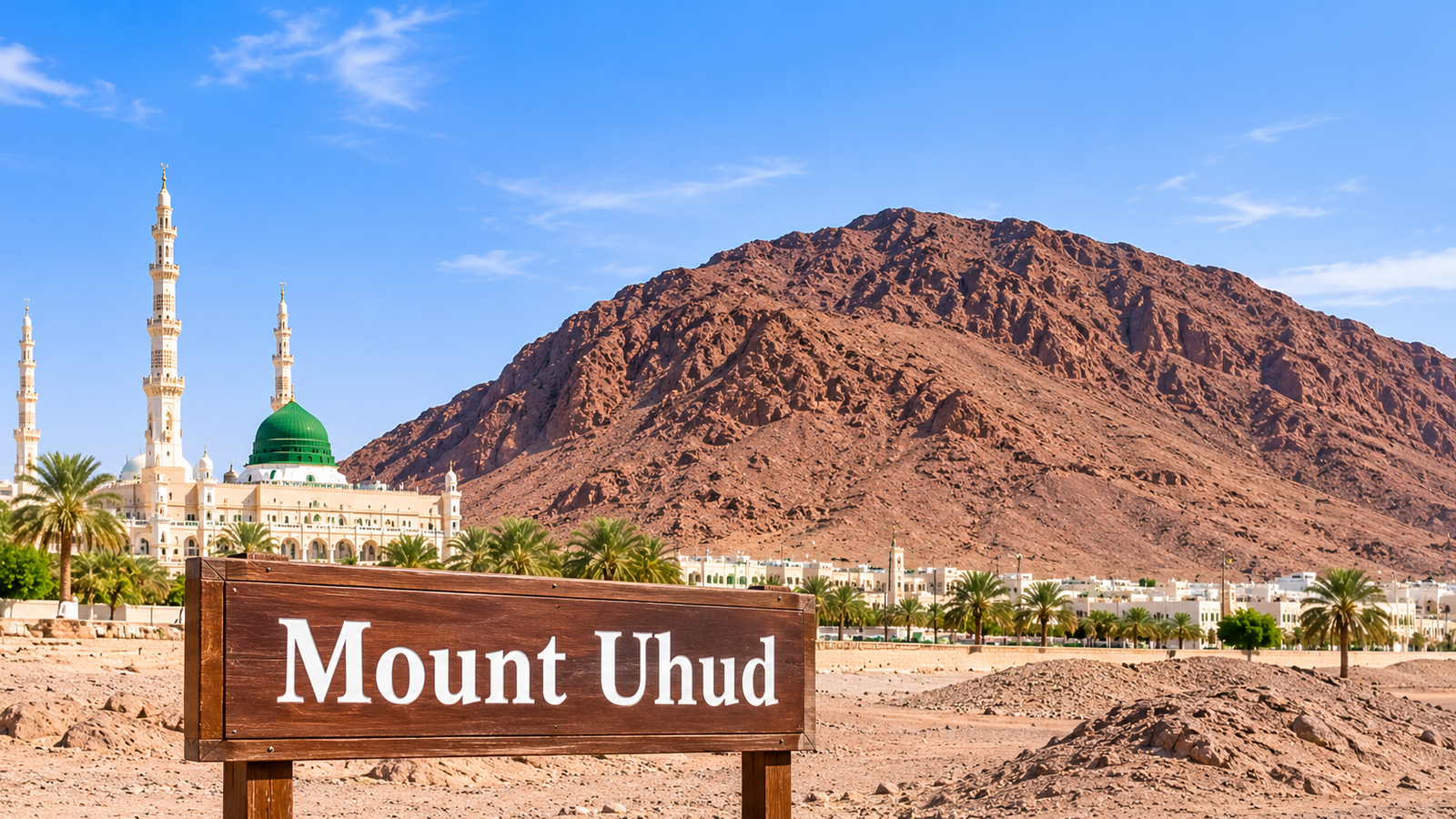
If you visit Madinah, you will see a long, reddish-brown mountain on the northern edge of the city. This is Mount Uhud. For many visitors, it is one of the most moving places on the trip, because of what happened at its foot more than 1,400 years ago.
In this guide, I will explain the story in plain words and share some practical tips, based on what I tell travellers before they go.
About Mount Uhud
Mount Uhud is a ridge of rock that stretches for several kilometres, north of the Prophet’s (S.A.W.) Mosque. It rises to roughly a thousand metres above sea level and stands apart from the other hills around Madinah.
The name is often explained as meaning “standing alone”. Whatever the exact origin, the shape fits. It is a strong, solid landmark that you can see from many parts of the city.
Why it matters to Muslims
Uhud is tied to a key moment in early Islamic history. It is also mentioned in the teachings of the Prophet Muhammad (peace be upon him), who is reported to have spoken of his love for the mountain.
For this reason, many pilgrims make time to see it during their stay in Madinah.
The Background to the Battle
To understand Uhud, we need to go back a year. In 624 CE, the Muslims of Madinah won the Battle of Badr against the Quraysh of Makkah, despite being far fewer in number.
The Quraysh were hurt and angry. They lost many of their leaders, and they wanted to restore their pride and their power. They spent the following year preparing for a rematch.
The Quraysh march north
In early 625 CE (3 AH), a Makkan army of about 3,000 men set out for Madinah. It was led by Abu Sufyan and included horsemen, camels and soldiers well equipped for battle.
When word reached Madinah, the Prophet (peace be upon him) discussed what to do with his companions. Many wanted to meet the enemy outside the city, and in the end the Muslims marched out.
A smaller force
Around 1,000 men left Madinah. On the way, about 300 turned back under Abdullah ibn Ubayy, leaving roughly 700 to face an army of 3,000.
The Muslims then took position at the foot of Mount Uhud, with the mountain protecting their backs.
The Battle Itself
The Prophet (peace be upon him) chose his ground with care. He placed a group of about 50 archers on a small hill beside the field, now often called the Mount of the Archers, to guard a gap in the line.
Their orders were clear: do not leave this position, whatever happens.
The early success
The fighting began, and at first the Muslims did well. Their line held firm and the Quraysh began to fall back.
Seeing this, many of the archers believed the battle was won. Most left their post to collect what the enemy had left behind.
The turning point
This was the moment the Quraysh cavalry had been waiting for. Khalid ibn al-Walid, who had not yet accepted Islam, saw the gap and led his horsemen around the hill and into the rear of the Muslim army.
The Muslims were now attacked from two sides. Confusion spread quickly, and a rumour that the Prophet (peace be upon him) had been killed made things worse.
Losses on the field
The Prophet (peace be upon him) was wounded, but he survived, and a group of loyal companions stayed around him to protect him.
About 70 Muslims were killed, among them Hamza ibn Abdul-Muttalib, the Prophet’s uncle. Hamza is remembered as a brave and much-loved man, and he is known as the “Lion of God”.
What Happened Afterwards
The Quraysh did not finish the job. They did not enter Madinah, and after the fighting they returned to Makkah.
The Muslims buried their dead near the battlefield, and the Prophet (peace be upon him) led them back into the city. The next day, he called the men who were able to fight to follow the Quraysh for a short distance, as a show of strength.
Lessons people draw from Uhud
Scholars and teachers have talked about Uhud for centuries. A few lessons come up again and again:
- The importance of obeying clear instructions in a time of danger
- The risk of letting the hope of gain cloud good judgement
- Patience and trust after a setback
- Unity within a community
You do not need to be an expert to feel the weight of these ideas when you stand on the site.
Visiting Uhud Today
Uhud is easy to reach from the centre of Madinah. Most people go by taxi, or as part of a guided tour, and the trip often takes a couple of hours.
What you can see
The main places visitors stop at are:
- The Martyrs’ Cemetery of Uhud: at the foot of the mountain, where Hamza and the other fallen companions are remembered
- The Mount of the Archers: the small hill where the archers were stationed
- The mountain itself: a good spot for photographs and quiet reflection
Some of the area is fenced, so you will usually view the cemetery from outside the wall.
Practical tips
A few things I always pass on:
- Go early in the morning or late in the afternoon, when it is cooler
- Wear modest clothes and comfortable shoes
- Bring water and a hat, as there is little shade
- Be respectful and keep your voice low near the cemetery
- Ask before taking photos of other visitors
A local guide can make a real difference here. They can point out where each part of the battle took place and tell the story as you walk.
Planning Your Trip
Uhud fits nicely into a wider visit to Madinah, alongside the Prophet’s Mosque, Quba Mosque and the Qiblatain Mosque. Many travellers also add a stop at the date markets, which make good gifts.
If you are putting together your first itinerary, Saudi Travel UK specialists can help with visas, hotels and local guides, so you can spend your time on the experience rather than the paperwork.
It is also worth checking current entry rules before you book, as these change from time to time. For up-to-date advice and tailored plans, speak with an adviser at Saudi Travel before you finalise your dates.
Final Thoughts
Mount Uhud is not a grand site in the way a palace or a fort can be. What makes it special is the story behind it, and the calm that many visitors feel there.
Give yourself enough time, go with a good guide, and let the place speak for itself. For most people I send there, it becomes one of the parts of the journey they remember best. With the right planning from Saudi Travel, a visit to Uhud can be thoughtful, comfortable and deeply meaningful.
 taper.empire
 semon.ashley
 matt.bennett